

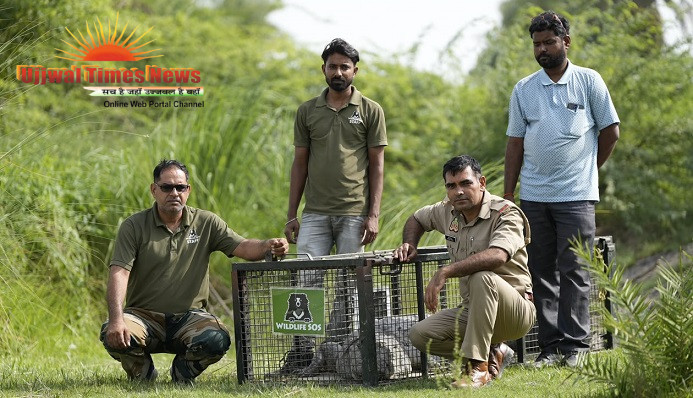
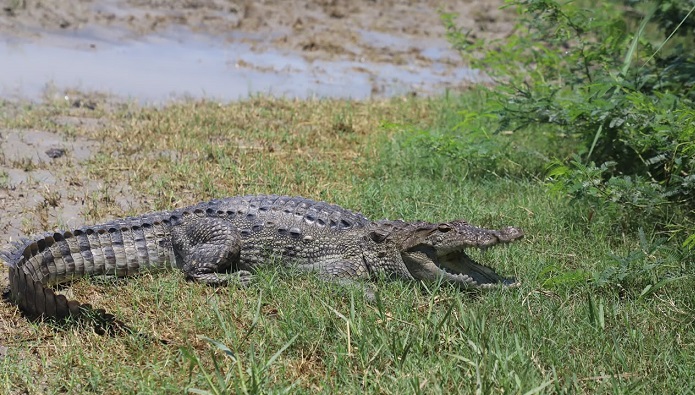
Etah,15 July 2026 (UTN).Panic gripped Maksudpur village in Uttar Pradesh's Etah district in the dead of night when a marsh crocodile, measuring approximately 9 feet in length, emerged from an irrigation canal and entered the inhabited area. As news of the crocodile's presence spread, villagers rushed out of their homes, creating an atmosphere of fear across the locality. Wildlife SOS's rapid response team was alerted to the incident around 2 AM, and a team of experts immediately set out for the site.
**Villagers Showed Courage, But the Risk Could Have Escalated**
By the time the rescue team arrived, villagers had already restrained the crocodile with ropes and taped its jaws shut to prevent it from moving further. While this mitigated the immediate danger, experts note that attempting to capture or restrain a wild animal in this manner can be extremely risky for both humans and the wildlife involved. A large crowd had gathered at the scene, further complicating the situation.
**Wildlife SOS Takes Charge**
The Wildlife SOS team first moved the crowd to a safe distance to ensure the rescue operation could proceed without interference. Subsequently, trained rescue experts carefully removed the tape from the crocodile's jaws and untied the ropes. Using specialized rescue equipment, the team safely secured and controlled the animal.
Utmost caution was exercised during the rescue to prevent injury to the animal while ensuring public safety. The team conducted a preliminary health assessment of the crocodile on-site.
**No Serious Injuries Despite Prolonged Restraint**
Experts reported that the crocodile was found to be in good health, despite having been restrained and under stress for an extended period. There were no signs of serious injury or fractures on its body. Following the examination, the crocodile was transported in a secure vehicle and released into a natural water body located at a safe distance from human settlements, offering an environment suitable for its natural way of life.
**Why Are Crocodiles Reaching Villages?** According to wildlife experts, rivers, canals, ponds, and other water bodies become interconnected during the monsoon season. As water levels rise, crocodiles are often swept away from their original habitats into new areas. Strong currents and expanded waterways can carry them close to human settlements.
Experts state that, in most cases, crocodiles do not enter villages with the intent to attack humans; rather, they are simply seeking a path to a safe water source. Crowds, noise, and being surrounded can cause them stress, thereby increasing the risk of accidents.
**Significance of the Marsh Crocodile**
The Marsh Crocodile (*Crocodylus palustris*)—locally known as the *Mugger*—is one of India's primary freshwater crocodile species. It inhabits rivers, lakes, ponds, dams, and marshy wetlands.
It is classified as 'Vulnerable' on the International Union for Conservation of Nature (IUCN) Red List. It enjoys the highest level of legal protection under Schedule I of India's Wildlife Protection Act, 1972. Hunting, capturing, harming, or illegally relocating the animal is a punishable offense.
**Vital for the Ecosystem**
Experts regard the crocodile as an apex predator within freshwater ecosystems. It plays a crucial role in maintaining ecological balance by preying on weak and diseased aquatic organisms. A healthy crocodile population is considered an indicator of a thriving ecosystem within a water body.
**Appeal by Wildlife SOS**
Kartick Satyanarayan, Co-founder and CEO of Wildlife SOS, noted that encounters between wildlife and humans increase during the monsoon. In such situations, people should maintain a safe distance rather than panicking and should immediately alert a trained rescue team. In this specific instance, timely information from locals and swift action by the rescue team ensured the safety of both the crocodile and the villagers. Geeta Seshamani, Co-founder and Secretary of Wildlife SOS, stated that a healthy crocodile population indicates the good condition of our freshwater resources. Attempting to capture, corner, or crowd around a crocodile not only endangers human lives but can also severely impact the animal's health due to prolonged stress.
Baiju Raj M.V., Director of Conservation Projects at Wildlife SOS, noted that fortunately, the crocodile sustained no injuries and was immediately released into a suitable natural habitat following a preliminary health check. He added that such incidents tend to increase during the monsoon season; therefore, people should not attempt to carry out rescues themselves.
What to do if you spot a crocodile?
Maintain a distance of at least 20–30 meters from the crocodile.
Do not try to corner, throw stones at, or chase it away.
Immediately move children and pets to a safe location.
Do not allow a crowd to gather.
Promptly inform the local Forest Department or a trained wildlife rescue team.
Under no circumstances should you attempt to capture or restrain the crocodile yourself.
Rising incidents of human-wildlife encounters
Experts believe that changing weather patterns, rising water levels during the monsoon, the expansion of water bodies, increasing pressure on natural habitats, and the expansion of human settlements are driving up incidents of human-wildlife conflict. In such situations, awareness, timely reporting, and the role of trained rescue teams are crucial. If a crocodile, snake, leopard, elephant, or any other wild animal is spotted in a populated area, do not panic; instead, immediately inform the concerned authorities or the Wildlife SOS helpline at +91-99171 09666. With timely information and expert assistance, the animals can be safely returned to their natural habitats, and any untoward incidents can be averted.
Wildlife SOS.